

Meaning of the logo

The KPTT logo is grounded in the foundation of living for others through a concept of profound simplicity, featuring two hands that symbolize dynamism and represent a space for harmonious collaboration. The symbolism of life, rendered through a leaf-shaped negative space on the thumb, embodies strength and virtue for life (Fully Human Fully Alive).
Meanwhile, the color green is used as it is intrinsically tied to KPTT’s brand identity in agriculture, while the leaf veins are shaped like waves to represent the dynamics of food technology. A small flame is set on the pinky finger (the smallest finger) as a representation of how a small action illuminates greater actions around it.
Competent, prosperous, dignified, and faithful farmers.
Delivering inspiring modern farming education in agriculture through practical methods and product outputs across all commodities and fields of activity.
Conducting proper, organic, and ecological training in crop and livestock farming.
Building networks with relevant stakeholders.
Profile
Taman Tani Agricultural Training Center (KPTT) Salatiga is an agricultural educational institution under the auspices of the Society of Jesus (SJ) order, founded in 1965. The institutional objective of KPTT is to advance socio-economic development, particularly in the agrarian sector, by offering agricultural courses, supporting farmers with innovative methods, and cultivating competent, self-reliant, compassionate, and conscientious farmer leaders. The work of KPTT, which is operated under the “Taman Tani” Foundation, is a Karya Propria (proprietary apostolate) belonging to the Society of Jesus. The Taman Tani Foundation is a public legal entity within the Unitary State of the Republic of Indonesia (NKRI). The Taman Tani Foundation is linked to the Society of Jesus through the Foundation’s Board of Trustees (Pembina), led by the Provincial Superior of the Society of Jesus. From the perspective of Canon Law / Church Law, KPTT’s apostolate is bound to the St. Stanislaus Community in Girisonta.
KPTT envisions itself as a modern farming educational institution that serves as a benchmark for anyone seeking to learn about agriculture and livestock farming. KPTT’s mission is to conduct modern farming education by delivering training and farming models that serve as inspiration in the agricultural field.


History of KPTT Salatiga
KPTT Salatiga was established on September 1, 1965, by three social, educational, and religious bodies: Ikatan Petani Pancasila (social), IKIP Sanata Dharma (educational), and Panitia Sosial Wali Gereja Indonesia (religious). The initial objective of founding KPTT was to advance socio-economic development, particularly in the agrarian sector, by conducting courses, assisting farmers through modern approaches, and developing competent, self-reliant, compassionate, and conscientious farmer leaders. As time progressed, KPTT continued to evolve and adapt to changing times. Since 2019, KPTT has adopted the Universal Apostolic Preferences (UAP)—the apostolic horizon of the global Society of Jesus—as a guiding framework for formulating its future vision and mission.
KPTT envisions itself as a modern farming educational institution serving as a benchmark for anyone wishing to learn about agriculture and livestock farming. KPTT’s mission is to conduct modern farming education by delivering training and farming models that inspire the agricultural sector, while fulfilling the preference to earnestly care for the earth as our Common Home. Concurrently, KPTT seeks to realize the option to walk alongside the poor and marginalized, accompany young people, and ultimately show them the pathways to God.
Over the past 6 years, several significant institutional milestones occurred at KPTT, including in 2016 when Fr. Sugiarta, SJ – the new Director of KPTT – initiated KPTT’s restructuring by optimizing various agricultural and livestock operations. From 2017 – 2019, swine farm facilities were upgraded by replacing breeding sows, overcoming swine pox disease, and renovating pig pens, fences, and retaining walls (talud), expanding breeding sows from just 5 to 60 heads; currently, KPTT’s swine herd averages 500 heads. In 2020, KPTT began scaling production and expanding post-harvest operations, including processing red ginger, coffee, pepper, and pork products, as well as renewing growing media and applying Hoagland nutrition and Trichoderma.
On August 29, 2020, an institutional shift occurred within the Taman Tani Foundation with the conclusion of the previous board’s term. A new executive board was formed, currently chaired by Fr. Sunu Hardiyanta, SJ. This leadership transition was formalized through the issuance of the foundation’s official deed of leadership change. Key developments included a logo redesign, launching online marketing, and selling post-harvest products.
After experiencing shared community living among the Jesuits, employees, and fellow farmers (teman tani), new ideas emerged to reinterpret KPTT’s apostolic work. As a concrete manifestation of KPTT’s apostolate—which had previously focused on education and production—it is envisioned to achieve a broader scope and tangible impact on the general public and farmers in particular. Looking ahead, KPTT aspires to truly be a Teman Tani (Farmers’ Companion). This is realized by becoming close companions to farmers, sharing knowledge on agricultural practices, and delivering educational programs that train dependable agricultural leaders. This dependability is reflected in farmers who possess strong character, self-reliance in acquiring agricultural inputs, and independence in post-harvest processing and marketing. In summary, farmers must be empowered to meet their agricultural needs from upstream to downstream.
KPTT continually learns, evolves, and adapts to the demands of changing times. One concrete step taken by KPTT has been updating the KPTT logo and developing a product brand identity. KPTT hopes that with a new logo and brand identity, it will become increasingly recognized and expand its reach in spreading its mission. Below is the transformation from the old logo to the new logo:

Meanwhile, KPTT uses the brand name “iniGo.” The rebranding to iniGo stems from the KPTT logo as a product sub-brand, signifying that iniGo and KPTT share the same underlying spirit. “iniGo” is actually a familiar term within the Society of Jesus, among alumni, and for anyone who has crossed paths with the Jesuits. iniGo reminds many of the childhood name of Ignatius of Loyola, founder of the Society of Jesus. Below is the image of the brand in question:

Location of KPTT Salatiga
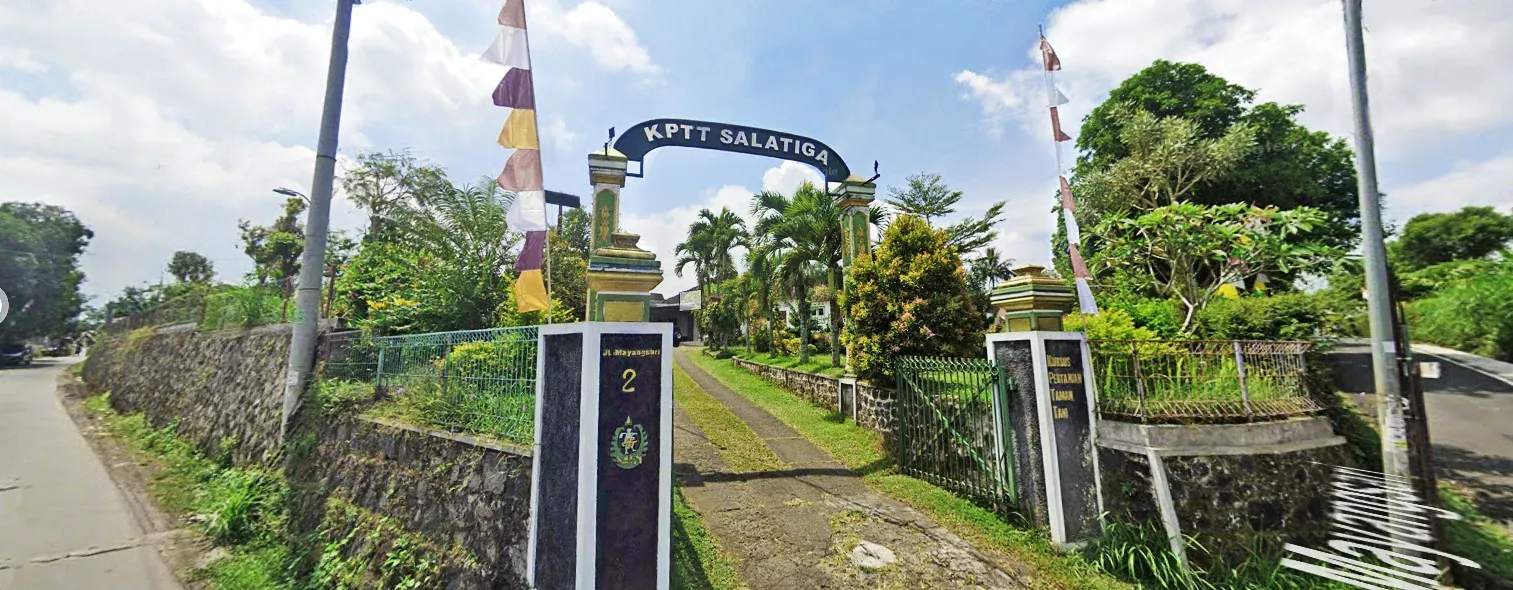
Taman Tani Agricultural Training Center is situated in Kutowinangun Lor Village (Kelurahan), Tingkir District (Kecamatan), Salatiga City, Central Java, geographically located between 110°30’41.2’’ to 110°30’43.7’’ East Longitude and 7°19’28.8” to 7°18’52.9’’ South Latitude. Salatiga City, specifically Tingkir District, Kutowinangun Lor Village, experiences an average temperature of 26˚C - 29˚C with an average annual rainfall of 2,999 mm/year. The climate in Salatiga City, specifically Kutowinangun Lor Village, is relatively cool. Kutowinangun Lor Village spans an area of 10 Ha, consisting entirely of dryland.
From the total available land, KPTT is divided into 3 areas. Area 1 (the central complex) houses the administrative offices, male and female dormitories, training rooms, dining hall, kitchen, and agricultural areas: nursery propagation, leafy green vegetable production, as well as cattle, goat, and poultry livestock units. All core training activities and production operations are centralized in this location.
Area 2 of KPTT is situated a short distance from Area 1 on Jalan Cempaka Sari. Area 2 features the newly opened KPTT STORE, serving as an outlet to market various agricultural and livestock products managed by KPTT. Previously, this site served as dormitories for 3-month course participants. Due to optimization efforts, Area 2 now serves as a facility to drive the marketing of KPTT products. Beyond housing the store, Area 2 is used for cultivating various fruiting vegetables and producing mushroom logs. Additionally, a large greenhouse stands on the site for growing vegetables and strawberries.
Area 3 of KPTT is located on Jalan Percik, Salatiga, approximately 3 kilometers from Area 1. Area 3 specializes in the cultivation of various plantation commodities, including robusta and liberica coffee, coconut, ginger, avocado, pepper, and many other plantation crops. The site also houses a swine farming facility for educational and production purposes. Area 3 is the largest site, covering approximately 7 Ha. It also features educational facilities that can be utilized for agritourism and outdoor activities such as outbound training.